church

497 posts · page 2 of 34

“Whose image is this?”

Andy Crouch on Mark 12:13-17 and its application to the U.S. Constitution’s three-fifths compromise:

Jesus asks for a coin and asks the seemingly innocent question: “Whose image [Greek, eikōn] is this? Whose title?” But the question is not innocent. Caesar has made the coin, imprinting his image upon it — ​so it is fine to give it back to him. But, then, who bears the image of God and thus belongs to Him? Human beings. Jesus’ answer not only evades His opponent’s trap — ​it raises the profound question of whether they, and we, are rendering all human beings to God with the dignity they deserve as His image bearers — ​or whether we are turning them into property and the currency of power and taxation.

I hadn’t really stopped to think about how Jesus’ teaching here doesn’t only ask his listeners what belongs to Caesar, but also, implicitly, what belongs to God. What bears his image?

“Advice is useless in bondage”

Excellent insight from Dr. Martyn Lloyd-Jones on “the futility of humanism:”

Here’s my challenge to humanism: What does humanism to give to a man that’s made a wreck of his life?

You see, they say that a man can save himself; all he needs is knowledge and understanding, but I know highly intelligent men who’ve made wrecks of their own lives. I know men who’ve passed through the best universities of this country, [yet] who are slaves to particular sins. And they’d do anything if they could only stop. They can’t stop.

What does all this clever talk and teaching offer to an ordinary man or woman in this world at the present time, who… makes any kind of effort and strives to save himself? What have [the humanists] got to give him? They’ve got nothing to give him nothing whatsoever. They say, “Well of course if you don’t accept our teaching, if you don’t pull yourself together and join the ethics of the humanistic society… well then we’ve got nothing to say to you.” And they haven’t anything to say, either.

They can only exhort you to do what they can’t do for themselves. This is the final failure of all humanism: that it leaves us helpless and hopeless in bondage… But advice is useless in bondage and serfdom…

No, no, the trouble is they don’t realize man’s complete helplessness. And he’s completely helpless because his very mind is darkened. His will is in a state of bondage. You see, these people, they don’t seem to have read the seventh chapter of the Epistle to the Romans, the profoundest bit of psychology ever written in this respect. There it is for you, set out by the Apostle Paul: “The will is present with me, but how to perform it, I know not.” The humanist can tell me what to do, but how am I to do it? [The humanist] tells himself what to do. Can he do it? Of course he can’t. “With my mind… I agree that the law of God is good. But I find another law in my members dragging me, tying me down to the law of sin and death. The evil that I would not want, I do. And the good that I want, I do not! Wretched man that I am!”

[The humanists] have never seen that. They’ve never seen that because their thinking is so utterly superficial. They’ve never realized the depth of the problem. They’re always talking outside themselves in some theoretical manner and have never faced the problem of their own lives and their own failure. Man in sin is completely helpless. Can’t do it, try as he will. This is the story of the best men that the world as ever known… This struggle, this endeavor, the futile endeavor to try to understand, to get some magical formula, to get some strength from somewhere, [to get something] that will enable them to rise up out of themselves to something bigger and higher and nobler. But they’ve all failed… “Without strength,” that’s the condition of every individual, and of the whole of the human race…

And here, you see, the whole thing changes. Why? Well not because of anything man has thought of or said or done, but because God. This is the message of Christianity: the only hope for an individual or for the world is in the intervention of God… And this is the message. This is Christianity. Not good advice. Not exhortation. But a proclamation and announcement that God has visited and redeemed his people. It is entirely God’s work. It is altogether from His side. It is unexpected. But as Paul puts it, there in the fifth chapter of the Epistle to the Romans in the sixth verse, “While we were yet without strength, in due time Christ died for the ungodly.” My dear friend, what amazes me is that the whole world doesn’t rise up onto its feet and shout out, “Hallelujah! Praise God!”

So much more in full sermon, including humanism’s tendency to “solve” all of society’s problems, yet have nothing to offer to the individual in crisis.

“What the heart most loves and wants the mind finds reasonable, the emotions find valuable, and the will finds doable”

Citing Augustine, Tim Keller makes “two brief points” about the Christian view of loving God:

  1. Loving God means loving him with the whole heart. In the Bible the heart is the seat of the mind, will, and emotions, together. The Hebrew leb (“heart”) is the center of the entire personality. The heart’s “love,” then, means much more than emotional affection. What the heart most loves is what it most trusts (Proverbs 3:5) and delights itself in (Proverbs 23:26). Matthew 6:21 says, “Where your treasures is, there your heart will be also.” What you treasure is what absorbs your attention and commitment the most. Whatever captures the heart’s trust and love controls our thoughts, feelings, and behavior too. What the heart most loves and wants the mind finds reasonable, the emotions find valuable, and the will finds doable.
  2. Loving God means loving him for himself. In Augustine’s theology, to love God supremely is to love him for himself alone, and not just for what you can get from him. “For there is a joy that is not given to those who do not love you, but only to those who love you for your own sake. You yourself are their joy. Happiness is to rejoice in you and for you and because of you” (Confessions, book X, chapter 22). Notice that it is possible to be very religious, to do prayers and religious observances, to be very ethical—but all so that God will give you good things. It is to use God rather than to love him, which Augustine says must never be done… Conditional service to God—serving him as long as he is answering prayers life—is a sign you are using him. When you stop obeying him when things go wrong in your life, that reveals that the good things and circumstances are the real nonnegotiables, your real loves. You were using God and loving things, rather than using things to love God. To love God for his own sake means to find him beautiful.1

Footnotes

  1. Tim Keller, Making Sense of God, p 288. (I added the paragraph break for readability.)

“Politics, power, and evangelical orphans”

Sharply written piece from Jared Wilson:

The evangelical generations are divided. That much is clear. It is a sad situation to see so many orphans. They’re reading all the old dead guys, because they can see how those guys finished. They can see who held the line all the way and who didn’t. They are listening to more non-white evangelicals, because those folks have learned how to persevere from the margins for centuries. And the upside to all of this is that the orphan will come home. These youngsters who have rejected your idolatrous politics, your nationalistic faith, your moral subjectivity, your fear of the alien and the stranger, your gospel neglect will finally do you proud when they inherit your churches.

The facility with which many evangelicals have pawned their own stated principles is as disheartening as it is revealing.

The Lindsay Bible Reading Plan

A year of reading, one book at a time

Lindsay: (ˈlɪndzɪ) n. (name, surname). Linden tree planted at the water.

Blessed is the one whose delight is in the law of the LORD, and who meditates on his law day and night. That person is like a tree planted by streams of water. –Psalm 1:1a-3a

Get started

Download the .pdf for your Bible — the explanation and the whole undated annual plan, two pages to print and mark off as you go.

What this is

Many great Bible reading plans and strategies have been developed over the centuries. The Lindsay Bible Reading Plan aspires to continue this legacy.

The reading plan has five principle aims:

  • Read for understanding • On average, each day has 3.5 chapters from just one book, followed by a brief Psalm stanza. By reading and completing one book at a time, deeper comprehension is more attainable.
  • Avoid getting “bogged down” • Throughout most of the plan, “alternating canonical order” guides the reader to complete an Old Testament book, followed by a New Testament book, followed by an Old Testament book, and so on. This helps to keep the reading fresh, while still beginning the year in Genesis and ending it with Revelation.
  • Pray the scriptures • In addition to a multi-chapter reading, each day has a bite-sized stanza from the Psalter designed to inform daily prayer. Just as God speaks to his people though the Bible, the Psalms help people to speak back to God.1
  • Grounded in Christian tradition • By dividing the daily readings between AM (longer reading) and PM (Psalm stanza), the reader can engage the age-old practice of morning and evening Bible meditation.
  • Compliment the local church • Sunday readings only contain the Psalm stanza, reserving the longer readings for Monday through Saturday. This leaves time on Sunday for meditating on the Bible passage from the reader’s church service.

When to begin

Now!

Even though Genesis 1 is read on January 1, there’s no reason to wait. Jump in with today’s date, and read on.

In other words, the best Bible reading plan is the plan that you actually do.2

Footnotes

  1. Want more? Each Psalm reading can be complimented with Tim and Kathy Keller’s The Songs of Jesus or with Derek Kidner’s commentaries. (I am indebted to these volumes for guiding the subdivision of the Psalms into a year of daily readings.)

  2. The same can be said of the “best” Bible version.

“We must not be snobs or snobs about snobs.”

Wisdom from Hidden Christmas by Tim Keller:

Here’s the challenge, though: We need Christians everywhere. That includes centers of power, where people of influence, talent, wealth, and beauty reside. But everything about Christmas teaches us not to have our heads turned by such people, not to be prejudiced in their favor. Christians must also live among them and love them and serve them as neighbors. There are temptations for those who do this. They must do so with no need or desire to get into the “inner ring” of coolness and power. [Because of the extraordinary circumstances of the Incarnation,] Christmas means that race, pedigree, wealth, and status do not ultimately matter. It means not being prejudiced against the poor — and not being biased against or for the well off. We must not be snobs or snobs about snobs.1

Footnotes

  1. Keller, Timothy. Hidden Christmas : the surprising truth behind the birth of Christ. New York, New York: Viking, 2016, 78.

“The best retelling of the Jesus story isn’t Narnia or Harry Potter”

Andrew Wilson for Christianity Today on how Old Testament stories point to Christ:

When, in Genesis 41, Joseph is finally vindicated, he emerges from the pit with a new face and new clothes (41:14). So does Jesus. Joseph’s appearance is immediately hailed as good news for the nation: Pharaoh says, “Can we find a man like this, in whom is the spirit of God?” (41:37). It is the same with Jesus. Joseph is exalted to the right hand of the highest authority (like Jesus), with emissaries sent before him (like us), crying out to all who can hear, “Bow the knee!” (41:43). The result is blessing for the world in fulfillment of the promise to Abraham, as we find in Jesus. The world comes hungry to Joseph and finds that he is the only one who can provide food that satisfies. In a far greater and more lasting way, we discover the same thing in Jesus, the Bread of Life.

Good read for the Advent season.

Practicing Advent with family and friends

Directing one’s attention to the miracle of Christ’s birth at anytime, let alone during the busy-year-end-crazy-fest, requires intentionality. That’s probably why traditional Christian calendars have long included the period of Advent: a few weeks set aside to emphasize the incarnation of God in the birth of Christ.

While most of us don’t celebrate the traditional feasts and other practices associated with the liturgical calendar, a simple way to practice Advent is to get a bird’s eye view of the whole story arc of the Bible and how it points to Jesus. There are lots of volumes to help you to dothis, including the excellent children’s book, The Jesus Storybook Bible.

Read aloud together

The Jesus Storybook Bible is a great way for kids and grownups to anticipate the arrival of Christ’s birth. By reading together each night beginning December 1st, you can start with Chapter 1, and end with the birth of Christ on Christmas Eve.

Of course, capturing the overarching Christian story is not just for kids. Take the opportunity to go deeper by reading (perhaps with a spouse, roommate, or friend) the corresponding scripture passage for each of the storybook’s chapters:

  1. Psalm 19 and Hebrews 1
  2. Genesis 1-2
  3. Genesis 3
  4. Genesis 6-8
  5. Genesis 11
  6. Genesis 12 (cf. Genesis 13-21)
  7. Genesis 22
  8. Genesis 29-30
  9. Genesis 37 and 42-45 (cf. Genesis 38-41; 46)
  10. Exodus 12:1-28 (cf. 3-13)
  11. Exodus 14-15
  12. Exodus 16-17
  13. Joshua 3 and 6
  14. 1 Samuel 16
  15. 1 Samuel 17
  16. Psalm 23 (cf. Psalm 51 and 2 Samuel 7)
  17. 2 Kings 5
  18. Isaiah 9:1-7 (cf. Isaiah 11, 40, 50, 53, 55, 60)
  19. Daniel 6
  20. Jonah 1-4 and Hebrews 1:1-2
  21. Ezra 7 (cf. Nehemiah 8-10 and Malachi 1, 3-4)
  22. Luke 1-2
  23. Luke 2 (again!)
  24. Matthew 2

Spend time intentionally

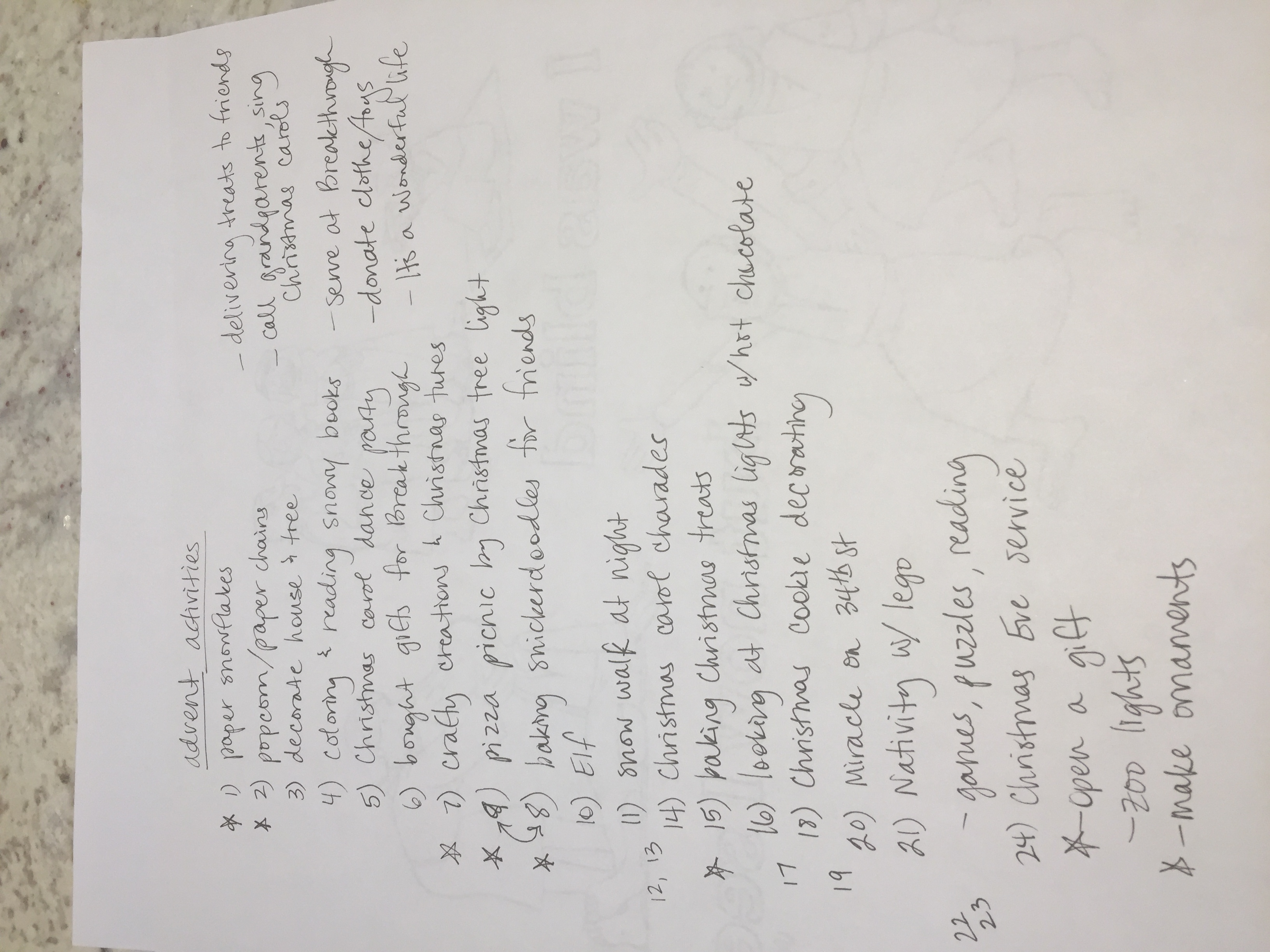
Spend time with the people closest to you on purpose. For example, in our house, we have a loose calendar1 of special activities to do almost every day of December. The point isn’t doing more, but to signal the season by doing differently.

Instead of turning on the Wii on the weekend, we can take a walk to enjoy neighborhood lights. It’s this intentional difference of activity that can help to shake us out of our cultural sleepwalking and — in conjunction with the purposeful Bible reading above — can help us to turn our minds to the utter miracle of God made human. When our kids ask, “Why are we taking treats to the neighbors?” we can say, “Giving and receiving gifts reminds us of the greatest gift.” When we eat treats ourselves (which we most certainly will), we can teach, “you think hot chocolate and cookies are great? God with us is vastly better than anything else.”

Advent reminds us that the best is yet to come.

Footnotes

  1. Here’s the calendar my wife has put together for us:

Lament Poems in the Bible

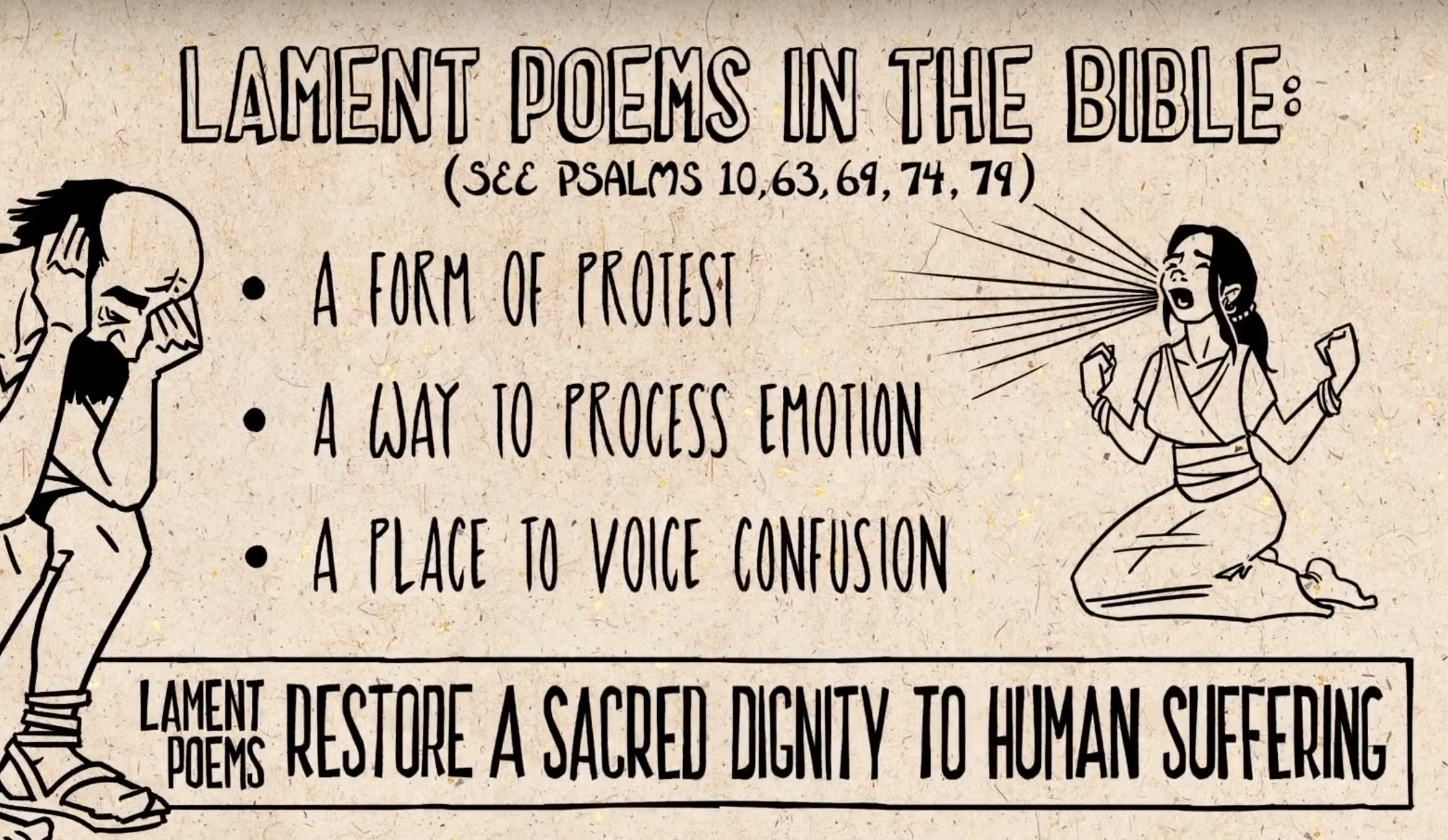
Overview of lament poetry in the Bible from The Bible Project’s1 video on Lamentations:

A form of protest, a way to process emotion, and a place to voice confusion — all to restore a sacred dignity to human suffering.

Excellent summary of biblical songs of lament, and an even better practice for the hurting and distressed.

Footnotes

  1. I’ve been watching the corresponding Bible Project video before beginning a new book of the Bible as I go through the Lindsay Bible Reading Plan. They are some of the best introductions that I’ve ever encountered.

“We are, all of us, far worse than merely ‘unsafe.’”

Rachael Starke writing on “sexual assault: a problem that crosses centuries” for Fathom:

Allard sees humanity, especially as influenced by culture, as “unsafe.” But the Christian worldview disagrees—the problem with Allard’s diagnosis is not that it’s too dark, but that it’s not dark enough. We are, all of us, far worse than merely “unsafe.” We are capable of sheer evil. But just as Christians believe the human problem is far greater, we believe just as strongly that an answer for our problem exists, one with power to not just make safe, but to make us truly good.

Few characters in the Old Testament exemplify this hope better than Boaz.

“This style of Christian worship may be easy to replicate, but one thing can’t be copied”

A minister blogs his experience of visiting a traditional church and an “atheist church” on the same Sunday:

Both were attended by a crowd of fashionable-looking young adults, mainly in their twenties and thirties. Although the sizes of the venues differed — HTB was bigger — both were nearly full. The form of the gathering was also very comparable. Both had a variety of notices and announcements, a collection taken during the ‘service’, tea and coffee for those attending, and ‘welcome’ information was available for newcomers. However, the parallels went deeper, too.

This “reductionism prevents us from learning the human stories behind the ideas”

Judy Wu Dominick for Christianity Today:

[We] admitted our tendency to recognize other people’s tribalism but less often our own. Consequently, we realized that we accuse our ideological opponents of dehumanizing vitriol while feeling perfectly justified in dehumanizing and abusing them. We also acknowledged our tendency to equate people with their ideas. This reductionism prevents us from learning the human stories behind the ideas—and when we don’t apply effort to learning those stories, we fail to become instruments of healing, justice, and reconciliation.

“The urban/rural divide is the single most overlooked fracture in American religion”

Emma Green on Radio Atlantic:1

I think that the urban/rural divide is the single most overlooked fracture in American religion, and particularly in the American church. With religious minorities… the enclaves are urban, concentrated populations where everybody in those communities is religious. But I think in Christianity, because it’s so huge and spread out, there are radically different orientations for those people who are in cities, and those people who are in suburbs, and more rural country.

More in the full podcast, including conversation about “how everyone, ‘religious’ or not, wants to be a part of something bigger than themselves, something transcendent.”

Footnotes

  1. Only a couple of weeks since launch, Radio Atlantic is already climbing to the top of my favorite podcasts.

“You can grow a church in one of the most post-Christian cities in the United States”

Sarah Eekhoff Zylstra profiles “the life and times of Redeemer Presbyterian Church” for TGC:

The spiritual scene wasn’t much better: Less than 1 percent of those in center city Manhattan self-identified as evangelicals. Without a lot more connections, experience, and money, you’ll have a really hard time, New York insiders told them. Odds are you won’t last five years.

But Keller’s plant has lasted nearly six times that long. When he preaches his last sermon on June 25, Redeemer will be 28 years old. Over nearly three decades, attendance has soared from around 50 to more than 5,000. The congregation expanded into two, then three locations. They ministered to thousands through Hope for New York, re-imagined employment through the Center for Faith and Work, and launched a church-planting hub now called City to City.

Through it all, Redeemer proved the impossible: You can grow an evangelical church in the middle of one of the most post-Christian, least Bible-minded cities in the United States.

Over the past 15 or so years, perhaps no single church (Redeemer) or person (Keller) have been as influential in educating the Western church at large about the importance of and strategy for urban church planting.